0.00 - 0.09 ; Straight cut / Close up into a tracking shot walking into house
0.09 - 0.10 ; Straight cut / High angle shot walking up stairs
0.10 - 0.12 ; Straight cut / Tracking shot mid shot, climbing stairs
0.12 - 0.14 ; Straight cut / Close up of texting on a phone
0.14 - 0.16 ; Straight cut / Over the shoulder shot, texting on a phone
0.16 - 0.18 ; Straight cut / Mid shot going up escalators
0.18 - 0.20 ; Straight cut / Over the shoulder shot, going up escalators
0.20 - 0.22 ; Straight cut / Rising up the escalator shot
0.22 - 0.23 ; Straight cut / Mid shot shoes
0.24 - 0.28 ; Straight cut / Symmetry shot walking up escalators
0.28 - 0.31 ; Straight cut / Establishing shot of stairs
0.31 - 0.32 ; Straight cut / Sam walking past camera on stairs
0.33 - 0.34 ; Straight cut / Back to the establishing shot but Sam closer to the camera
0.34 - 0.35 ; Straight cut / Mid shot of couple and Sam walking past
0.35 - 0.37 ; Straight cut / Sam looking at couple and walking past
Showing posts with label Unit 31: Editing. Show all posts
Showing posts with label Unit 31: Editing. Show all posts
Tuesday, 12 June 2018

Summer Task Three - Development of editing
 Primary methods of editing were very simple, for example the editor’s had to physically cut and glue parts of the film together in order to create continuous film. This was made possible by holding the film up to a light source and correctly identifying the desired frame to cut and/or join together. This method of work was very much dull and time consuming, however this method formed the under-structure of editing techniques.
The 'Moviola’ was introduced into the world of film in the year 1924. The 'Moviola' was a piece of editing technology. This particukpiece of editing equipment allowed editing within film to become much easier and allowed the editor to have a more precise method of editing film. It also brought about 'Edge Numbering’which allowed audio and visual to be edited in synchronisation.
In 1953, Steenbeck released their first Flatbed 16mm 4 Plate, ‘The ST200’ was born. ‘The ST200’ editor included optical sound and playback of 16mm perforated magnetic tape. The prime editing methods were still very practical and require the use of trim bins, guillotine’s and the use of a light table. ‘The ST100’ then followed, which was a 4 plate 35mm editor released in 1954. Following ‘The ST100’ was the first editor with back projection on a ground glass was the 35mm ‘The ST400’ which was later followed by ‘The ST500’ a switchable for standard film and Cinemascope.
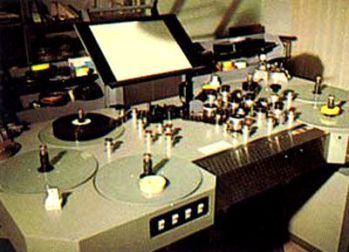 Live television editing became the pioneering form of editing, which began in the early of the mid 40’s which led to ‘Kinescope Recordings’, which consisted of a camera recording a video screen of a live broadcast. This later proven to not be a very successful method as it led to various issues such as ghosting and banding, nonetheless TV Studios were using more ‘Raw Film’ in their ‘Kinescopes’, than most Hollywood film studios combined.
Non-linear editing is a form of offline editing, where raw footage is copied and edited without affecting the original tape, and the offline approach has been in film editing since the start. Offline editing is essentially the whole editing process, where editors cut and piece clips together in order to tell a story. However, online editing is a process that is performed in the final stages of the production, and is the fine-tuning of the project. This focuses on aspects such as the quality of the picture, colour correction, visual effects, and other fine details of the project. The online editor will also ensure that the production is broadcast safe by ensuring certain aspect ratios and video levels.
This method of editing is called Linear editing, the process of selecting, modifying, and arranging images and sound in a predetermined sequence. The simple hardware such as the moviola means that this method of editing is inexpensive and quicker for smaller editing jobs. However, in 1971 the first non-linear editor was introduced. The CMX-600 was a digital console consisting of two monitors. The right monitor played the preview video, and was used by the editor to make cuts and edits; the monitor on the left was used to display the edited video. It wasn't until 1991 that the term 'non-linear editing' became officially formalized, when companies such as 'Avid' publicly introduced their device: the Avid 1. At this point digital products began to replace the classic editing tools such as the moviola. This form of editing was largely computerized and operated in a way the the original content isn't modified during the editing, therefore editors didn't have to start over if a mistake was made. This was a huge development it allowed editors to access any frame in a digital video clip and 'cut-and-paste' that clip to a different part of the sequence.
- Non-Linear Editing System: https://en.wikipedia.org/wiki/Non-linear_editing_system
- https://www.britannica.com/biography/Edwin-S-Porter
Thursday, 24 May 2018
Thursday, 17 May 2018
Shot type explanations
Shot Reverse Shot -
Shot reverse shot or also known as shot/countershot is a film technique where one character is shown looking at another character (the other character is more than likely off-screen), and then the other character is shown looking back at the first character.
180 Degree Rule -
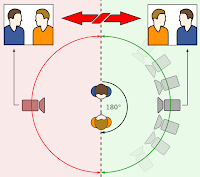
The 180 degree rule is a cinematography guideline that states that two characters in one scene should maintain the same left/right coordination to one another. When the camera passes over the invisible axis connecting the two subjects, it is called crossing the line and the shot becomes what is called a 'reverse angle'.
30 Degree Rule -
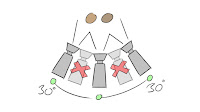
The 30-degree rule is a basic film editing guideline that states the camera should move at least 30 degrees relative to the subject between successive shots of the same subject.
Cut In -
In film a cut in shot is the interruption of a continuously filmed action by inserting a view of something else. It is usually, although not always, followed by a cut back to the first shot, when the cutaway avoids a jump cut. The shot is only on screen for no longer than 2-3 seconds.
Cross Cutting / Parallel Editing -
Cross-cutting is an editing technique most often used in films to establish action occurring at the same time, and usually in the same place. In a cross-cut, the camera will cut away from one action to another action, which can suggest the two actions are happening simultaneously. However it is not always the case.
Establishing Shot -
An establishing shot is usually the first shot of a new scene, designed to show the audience where the scene is taking place. It is usually an extreme wide shot.
Match On Action -
Or also known as 'Cutting on Action' is an editing technique or continuity editing in which one shot cuts to another shot portraying the action of the subject in the first shot. This creates the impression of a sense of continuity. The action carrying through creates a "visual bridge" which draws the viewers attention away from slight cutting continuity issues.
Temporal Overlap -
When an action is repeated from a different point of view.
Kuleshov effect -
A recognition that a shot’s meaning is not only dictated by what it contains, but by its relationship to other adjacent shots
Eisenstein Montage -
An approach to editing developed by filmmakers in the Soviet Union in the 20s. It emphasises dynamic, often discontinuous, relationships between shots and the juxtaposition of images. It’s primary focus was to engage with the viewer in an intellectual manner
Shot reverse shot or also known as shot/countershot is a film technique where one character is shown looking at another character (the other character is more than likely off-screen), and then the other character is shown looking back at the first character.
180 Degree Rule -

The 180 degree rule is a cinematography guideline that states that two characters in one scene should maintain the same left/right coordination to one another. When the camera passes over the invisible axis connecting the two subjects, it is called crossing the line and the shot becomes what is called a 'reverse angle'.
30 Degree Rule -

The 30-degree rule is a basic film editing guideline that states the camera should move at least 30 degrees relative to the subject between successive shots of the same subject.
Cut In -
In film a cut in shot is the interruption of a continuously filmed action by inserting a view of something else. It is usually, although not always, followed by a cut back to the first shot, when the cutaway avoids a jump cut. The shot is only on screen for no longer than 2-3 seconds.
Cross Cutting / Parallel Editing -
Cross-cutting is an editing technique most often used in films to establish action occurring at the same time, and usually in the same place. In a cross-cut, the camera will cut away from one action to another action, which can suggest the two actions are happening simultaneously. However it is not always the case.
Establishing Shot -
An establishing shot is usually the first shot of a new scene, designed to show the audience where the scene is taking place. It is usually an extreme wide shot.
Match On Action -
Or also known as 'Cutting on Action' is an editing technique or continuity editing in which one shot cuts to another shot portraying the action of the subject in the first shot. This creates the impression of a sense of continuity. The action carrying through creates a "visual bridge" which draws the viewers attention away from slight cutting continuity issues.
Temporal Overlap -
When an action is repeated from a different point of view.
Kuleshov effect -
A recognition that a shot’s meaning is not only dictated by what it contains, but by its relationship to other adjacent shots
Eisenstein Montage -
An approach to editing developed by filmmakers in the Soviet Union in the 20s. It emphasises dynamic, often discontinuous, relationships between shots and the juxtaposition of images. It’s primary focus was to engage with the viewer in an intellectual manner
Thursday, 10 May 2018
Labelling Footage

As you can see here this is a shared One Drive account for the HNC for when we went down to Bristol. We decided to put all our work together and so we didn't have to look at all the footage for what we wanted we all labelled it to make it easier for us
Friday, 27 April 2018
Evaluation - Promotional Video
At the start of this unit I was working alone with my ex driving instructor as my client but as he was messing me about with planning and recording I decided to sack him.
After initial communication my client we can to the conclusion that we both wasn't free at the same time as each other, and he also was not committed to making a promotional video. Therefore, I then overcame this problem by talking to my teacher and there was another person in the HNC who had also sacked their client. We both overcame this problem by deciding to work together as it would be to late to start a whole new video by ourselves. So, I then paired with Ben as he also sacked his first client, and we decided to do a promotional video for the HNC we are studying and for college purposes. Our client was Chris, who is the head of the media department in college.
Regarding our target audience, when in the first meeting with Chris, our client, we all decided that our target audience would be for the ages between 17-19. This is because when distributing our video, it would be the most effective method because students might not want to go university or go straight into a job. We can achieve reaching this particular audience by making a short 1 minute video for Instagram or even shorter for snapchat. This would've be beneficial for us as it would cater for our particular demographic and potentially receive a better response.
After initial communication my client we can to the conclusion that we both wasn't free at the same time as each other, and he also was not committed to making a promotional video. Therefore, I then overcame this problem by talking to my teacher and there was another person in the HNC who had also sacked their client. We both overcame this problem by deciding to work together as it would be to late to start a whole new video by ourselves. So, I then paired with Ben as he also sacked his first client, and we decided to do a promotional video for the HNC we are studying and for college purposes. Our client was Chris, who is the head of the media department in college.
Planning the promotional video went quite well as Ben and I had different ideas of what we wanted for the video however, as we have previously worked together it was quite easy to come to a compromise about what we wanted. We also watched a bunch of college/school promotional videos to see if they inspired us. A couple of the videos did and then the other couple didn't. After watching these videos we had a bunch of ideas of what we wanted for the video we were making and then presented them to Chris, with a powerpoint presentation. When we presented our ideas to our client, there were some changes he wanted or more things to add. This was really helpful to us as we had some missing pieces of the puzzle that we wasn't sure how to fill.
We then contacted ex students, current students and teachers to see if they wouldn't mind being in the video for us. As I had the role of communication with the client, which Ben overlooked (and those who were involved in the video), the communication on their part was not what we were expecting. We had shooting days planned with some ex students who then on the day let us down, that then pushed us back with only having one ex student to record.
During the production we got most of the footage we were hoping to get but unfortunately we did not manage to record everything our client wanted due to reliability and availability of ex students, current students and teachers. We accommodated this by asking all the interview questions to the available students in order to still cater for the information we wanted and needed.
During the production we got most of the footage we were hoping to get but unfortunately we did not manage to record everything our client wanted due to reliability and availability of ex students, current students and teachers. We accommodated this by asking all the interview questions to the available students in order to still cater for the information we wanted and needed.
Some of the errors we had were the sound, lighting and the grain on some clips. For example shooting in the studio and only recording with the microphone on the camera (which had been suggested to us as it is a quiet room) did not work as well as expected. This is because of the ex student and teacher were both very quiet when talking and it made the room have a bit of an echo and emptiness. To improve on this next time we would use a separate microphone to record the audio, and this would give us better sound quality.
Another thing we could've improved on was the lighting. When recording in the HNC room, the camera screen recording looked perfectly exposed, although when we put the footage onto our laptops to edit, the footage had a yellow/green tint due to the natural lighting. This became an error for us because it is not what we wanted for our video.
One thing I could've improved more upon was my research into the school and college promotional videos. I believe that if I were to look into more general promotional videos and compare them to the college/school videos I would've had a better idea on what to have in my video. For example the backgrounds were not the best within our video but if I were to look further into the videos I could've seen the backgrounds and not just focused on the foregrounds. Although saying this, whilst looking at college/school promotional videos I knew what I did not want to include within the video. For example, we saw a 'promotional video' but when we watched it, the video was more like a music video in a school. Maybe even something relating to High School Musical films, and we knew straight away that this is what we did not want.
Within the final cut of the video, we decided to only use one interview, involving Connie and Emily. This is because we believe that their answers contained the right amount of information we needed about the HNC and the teachers. Additionally, the quality of some of the interviews were not acceptable for the video and could not be used. The problems have been previously mentioned.
One thing I could've improved more upon was my research into the school and college promotional videos. I believe that if I were to look into more general promotional videos and compare them to the college/school videos I would've had a better idea on what to have in my video. For example the backgrounds were not the best within our video but if I were to look further into the videos I could've seen the backgrounds and not just focused on the foregrounds. Although saying this, whilst looking at college/school promotional videos I knew what I did not want to include within the video. For example, we saw a 'promotional video' but when we watched it, the video was more like a music video in a school. Maybe even something relating to High School Musical films, and we knew straight away that this is what we did not want.
Within the final cut of the video, we decided to only use one interview, involving Connie and Emily. This is because we believe that their answers contained the right amount of information we needed about the HNC and the teachers. Additionally, the quality of some of the interviews were not acceptable for the video and could not be used. The problems have been previously mentioned.
Regarding our target audience, when in the first meeting with Chris, our client, we all decided that our target audience would be for the ages between 17-19. This is because when distributing our video, it would be the most effective method because students might not want to go university or go straight into a job. We can achieve reaching this particular audience by making a short 1 minute video for Instagram or even shorter for snapchat. This would've be beneficial for us as it would cater for our particular demographic and potentially receive a better response.
Overall, both Ben and I are pleased with the final cut of the video, however with the smaller and limited time frame we had, we weren't able to include parts of the video like we had planned. I believe that we captured the natural essence of what the HNC life is like within college. This was achieved by maintaining an informal mode of address within the interviews and therefore keeping the responses natural and real. We emphasised this by the 'unpolished' feel of some of the clips we used, this added personality to the interviewees and represented the relationships and friendships that have been formed from the HNC.
An issue that we came across when editing the video was that sometimes the interviewees were too quiet compared to the backing soundtrack at some points of the video. This made it quite difficult to hear so in future we may find backing music which is quieter or like previously mentioned, use an external microphone to record the audio. Although we overcame this by altering the audio levels which still worked.
An issue that we came across when editing the video was that sometimes the interviewees were too quiet compared to the backing soundtrack at some points of the video. This made it quite difficult to hear so in future we may find backing music which is quieter or like previously mentioned, use an external microphone to record the audio. Although we overcame this by altering the audio levels which still worked.
Thursday, 26 April 2018
Evaluation - Music Video
When I was in second year photography the song that I chose for this unit - Rise up by Thomas Jack, was potentially one of the songs I was gonna use for my photography exam, however I did not. This is what inspired me to use this song for this unit. Although both my ideas from what it is now to what it was are very different, I think it shows development of what I have learnt in this HNC.
After planning and doing a focus group my final idea came into place and I couldn't wait to get recording. My initial ideas for the song was smoke and people in a relationship being all happy but then my final ideas came into place that I was not going to record a couple, but have Sam (protagonist) chasing after a girl to be in a relationship with them. I decided this because I knew I could create a good narrative with enigma codes to keep my audience intrigued to know what will happen at the end of the song.
Once I had finished my initial planning I had a meeting with my friend Sam about if he was comfortable doing all this stuff that I had planned for the video and then also when we could record and what days we were all free together. Luckily we got 2 days or 3 days if we needed it for filler footage, of recording planned.
I believe that my research during this unit was better improved from the last units as I knew what I needed and did not do in the last units so I did it all this time. As I wanted to use a song I had previously thought about using before, I already had analysis of the lyrics which may have given me an advantage however, after my focus group I found that I was looking more into the lyrics then being too literal about it all.
As my song is a hybrid I decided to watch many music videos of all the genres that are within this song. This helped me visualise ideas for the different parts of the song. By this I mean that throughout the song the tempo changes, as there are slow paced parts and fast paced parts of the song. However, I think that watching too many videos gave me too many ideas and I wanted to cram it all into the video but when it came to the editing I found that it would be impossible to add it all in, but not just when I was editing, but when I was filming too.
One thing I could've mostly improved on whilst researching everything for my music video would be timing. I think this because I found that I didn't do any further research into the weather (although it didn't really affect my video) and how to shoot some of the shots. I should've also researched into using a steadicam for the moving parts of the song although parts of me loves the hand held camera and the real feeling to the feeling.
As the song is called 'Rise up' and nearer the chorus some lyrics go 'rise up like smoke' and from these lyrics and my initial ideas I decided that I would have the first and last shot the exact same. However, Sam will be in different locations and smoking (vaping as it creates more smoke). This shows that Sam has been going round in circles and rising up all the levels to get his girl but at the end where he thought they were meeting, she wasn't there. So where were they meeting? Is she even real? It is open for interpretation depending on how you have read the music video. I also thought about the lyrics of the song 'Rise up' and thought I could have Sam on different levels trying to connect with this girl but keep having to rise up stairs, elevators, ramps etc... to try and keep up with her. The reason I did this was because I wanted some of my song to connect with the lyrics but as I was editing to the song it still had to make sense throughout the video for the narrative to work.
I had one massive music video influence with what I was recording and that was Radiohead(s) music video for their song 'Daydreaming'. The repetitiveness is what I wanted to occur in my video, however I wanted more enigma codes going on in my video. I also decided that I should add in more shot types and angles.
I decided to have continuity in my video with the song lyrics connecting to what is happening in the video because I want the audience to know what is going on but there still being the enigma codes on what his final goal is. Although we know there is a girl texting him, we don't know if she's real or why he wants to get wherever she is so bad.
In a part of my video continuity does not take place and it was completely unintentional. Between 0:30 and 0:41 the couple changes what they are doing from holding each others hands to hugging. Although their position is correct, the male standing in the same place in all shots and the same for the female
When editing my music video I decided to edit to the song and not to the lyrics as through the verses the beat is slower paced than the chorus. With this information I did a combination of fast paced and slow paced editing depending on what part of the song it was.
I believe that if you edit to the lyrics sometimes the video can become to literal and this is what I wanted to avoid for my narrative. When I was planning for this potential music video in my A levels, I broke all the lyrics down and I knew it would be too hard to record and put together.
I also found that I did not need all the footage I had recorded when I got nearer the end of the edit, but when I was only just starting to edit I was scared I did not have near enough the footage I needed! I thought this because of the way I decided to edit - fast and slow paced. However, at the end of my video the song is fast paced and my editing is slow paced and this is because towards the end of video he realises that she isn't there which makes him want to slow his pace down.
In contrast to the fast paced music, I decided to slow down the editing to portray the gradual realisation that the mystery girl is not at the desired location.
Recording went really well as we only needed 2 out of the 3 days we planned for. Within the 2 days we were Nuneaton and Coventry for at least 4 hours recording and scouting out where we could record. I even managed to have some couples (my friends) in the recordings which is what I thought I wouldn't be able to do due to availability on the days we planned to originally record. I overcame this issue by changing the Friday recording day to Thursday when the two couples were free and I am really happy that I didn't have to change so much of my concept.
When editing I also noticed that at 0:17 Sam is not in focus but the escalators are, at first I thought I might have to go re shoot this part of the video but then I adapted to the idea that Sam shouldn't always be in focus as it is about him and his journey. And, to Sam the journey is the most important thing to get to his one true love. I also like how the escalator is in focus as its going up, or as the song goes the escalators rise up like smoke.
During the editing it also took me longer to get the correct positions of Sam. For example, what I mean by this is; when he is looking at the couples whilst walking past them or when he was taking off his jacket nearer the end of the video. If he was looking at the when I cut the last shot he had to be looking at the at the start of the next shot, again showing continuity.
If I were to do this project again I would most like to improve is where I shot some of footage, this is because I feel like the exposure, based on the ISO, is a bit grainy. This is due to me not taking my camera out with me on location scouts. If I were to take my camera with me whilst I was scouting out locations to see how it looked on camera I could've decided if I needed an extra light source, for example, a portable LED light. Although with some of the shots I took the LED light may of been an issue unless I were to place it in a secret place.
Another thing I would've like to improve is the continuity during my video, I know that in music videos continuity isn't needed however I feel like it makes the video feel more real. What I mean by this is that some music videos tell a story and have a narrative, which mine does, however unless you are looking at every detail, you don't really notice it.
I am very pleased with how my final production came out and to be honest it is better then I thought it could be. I also like how I kept the sound of the wind in on the last shot of the video. I did this because the song music went quiet and I thought that the effect of the wind hitting the camera microphone would add the effect of reality. The reality you don't get everything you want.
After planning and doing a focus group my final idea came into place and I couldn't wait to get recording. My initial ideas for the song was smoke and people in a relationship being all happy but then my final ideas came into place that I was not going to record a couple, but have Sam (protagonist) chasing after a girl to be in a relationship with them. I decided this because I knew I could create a good narrative with enigma codes to keep my audience intrigued to know what will happen at the end of the song.
Once I had finished my initial planning I had a meeting with my friend Sam about if he was comfortable doing all this stuff that I had planned for the video and then also when we could record and what days we were all free together. Luckily we got 2 days or 3 days if we needed it for filler footage, of recording planned.
I believe that my research during this unit was better improved from the last units as I knew what I needed and did not do in the last units so I did it all this time. As I wanted to use a song I had previously thought about using before, I already had analysis of the lyrics which may have given me an advantage however, after my focus group I found that I was looking more into the lyrics then being too literal about it all.
As my song is a hybrid I decided to watch many music videos of all the genres that are within this song. This helped me visualise ideas for the different parts of the song. By this I mean that throughout the song the tempo changes, as there are slow paced parts and fast paced parts of the song. However, I think that watching too many videos gave me too many ideas and I wanted to cram it all into the video but when it came to the editing I found that it would be impossible to add it all in, but not just when I was editing, but when I was filming too.
One thing I could've mostly improved on whilst researching everything for my music video would be timing. I think this because I found that I didn't do any further research into the weather (although it didn't really affect my video) and how to shoot some of the shots. I should've also researched into using a steadicam for the moving parts of the song although parts of me loves the hand held camera and the real feeling to the feeling.
As the song is called 'Rise up' and nearer the chorus some lyrics go 'rise up like smoke' and from these lyrics and my initial ideas I decided that I would have the first and last shot the exact same. However, Sam will be in different locations and smoking (vaping as it creates more smoke). This shows that Sam has been going round in circles and rising up all the levels to get his girl but at the end where he thought they were meeting, she wasn't there. So where were they meeting? Is she even real? It is open for interpretation depending on how you have read the music video. I also thought about the lyrics of the song 'Rise up' and thought I could have Sam on different levels trying to connect with this girl but keep having to rise up stairs, elevators, ramps etc... to try and keep up with her. The reason I did this was because I wanted some of my song to connect with the lyrics but as I was editing to the song it still had to make sense throughout the video for the narrative to work.
I had one massive music video influence with what I was recording and that was Radiohead(s) music video for their song 'Daydreaming'. The repetitiveness is what I wanted to occur in my video, however I wanted more enigma codes going on in my video. I also decided that I should add in more shot types and angles.
I decided to have continuity in my video with the song lyrics connecting to what is happening in the video because I want the audience to know what is going on but there still being the enigma codes on what his final goal is. Although we know there is a girl texting him, we don't know if she's real or why he wants to get wherever she is so bad.
In a part of my video continuity does not take place and it was completely unintentional. Between 0:30 and 0:41 the couple changes what they are doing from holding each others hands to hugging. Although their position is correct, the male standing in the same place in all shots and the same for the female
When editing my music video I decided to edit to the song and not to the lyrics as through the verses the beat is slower paced than the chorus. With this information I did a combination of fast paced and slow paced editing depending on what part of the song it was.
I believe that if you edit to the lyrics sometimes the video can become to literal and this is what I wanted to avoid for my narrative. When I was planning for this potential music video in my A levels, I broke all the lyrics down and I knew it would be too hard to record and put together.
I also found that I did not need all the footage I had recorded when I got nearer the end of the edit, but when I was only just starting to edit I was scared I did not have near enough the footage I needed! I thought this because of the way I decided to edit - fast and slow paced. However, at the end of my video the song is fast paced and my editing is slow paced and this is because towards the end of video he realises that she isn't there which makes him want to slow his pace down.
In contrast to the fast paced music, I decided to slow down the editing to portray the gradual realisation that the mystery girl is not at the desired location.
Recording went really well as we only needed 2 out of the 3 days we planned for. Within the 2 days we were Nuneaton and Coventry for at least 4 hours recording and scouting out where we could record. I even managed to have some couples (my friends) in the recordings which is what I thought I wouldn't be able to do due to availability on the days we planned to originally record. I overcame this issue by changing the Friday recording day to Thursday when the two couples were free and I am really happy that I didn't have to change so much of my concept.
When editing I also noticed that at 0:17 Sam is not in focus but the escalators are, at first I thought I might have to go re shoot this part of the video but then I adapted to the idea that Sam shouldn't always be in focus as it is about him and his journey. And, to Sam the journey is the most important thing to get to his one true love. I also like how the escalator is in focus as its going up, or as the song goes the escalators rise up like smoke.
During the editing it also took me longer to get the correct positions of Sam. For example, what I mean by this is; when he is looking at the couples whilst walking past them or when he was taking off his jacket nearer the end of the video. If he was looking at the when I cut the last shot he had to be looking at the at the start of the next shot, again showing continuity.
If I were to do this project again I would most like to improve is where I shot some of footage, this is because I feel like the exposure, based on the ISO, is a bit grainy. This is due to me not taking my camera out with me on location scouts. If I were to take my camera with me whilst I was scouting out locations to see how it looked on camera I could've decided if I needed an extra light source, for example, a portable LED light. Although with some of the shots I took the LED light may of been an issue unless I were to place it in a secret place.
Another thing I would've like to improve is the continuity during my video, I know that in music videos continuity isn't needed however I feel like it makes the video feel more real. What I mean by this is that some music videos tell a story and have a narrative, which mine does, however unless you are looking at every detail, you don't really notice it.
I am very pleased with how my final production came out and to be honest it is better then I thought it could be. I also like how I kept the sound of the wind in on the last shot of the video. I did this because the song music went quiet and I thought that the effect of the wind hitting the camera microphone would add the effect of reality. The reality you don't get everything you want.
Tuesday, 24 April 2018
Tuesday, 27 March 2018
Rendering footage

When editing I like to render my footage as I go along as it takes a while for everything to render if you do it all in one. I also like to look over the footage I have to put together and if it is not rendered it skips through the footage. (this is due to the footage not being linked)
Labelling of bins

I've labelled these bins for the workout days.
Chest - all the chest day footage is in here
Back - all the back day footage is in here
Legs - all of leg day footage is in here
Arms - all of arm day is in here
Run - the running footage is in here
Other - this is full of other little workouts that we thought we could use as filler footage if needed.
Subscribe to:
Posts (Atom)